
Espérons que la prochaine fois que tu voyageras dans un pays hispanophone, tout se passera bien et que tu auras les meilleures occasions de mettre en pratique ce que tu as appris. Cependant, il est toujours bon de se préparer au pire. Ici, nous allons te montrer quelques mots de vocabulaire touristique d'urgence qui pourraient t'être utiles si tu as besoin d'aide ou [...]
One of the most challenging parts of learning a new language is navigating the aspects that don’t exactly translate. Do you remember learning false friends and learning that different languages don’t always follow the same patterns? Just like other grammatical rules that don’t literally translate, it’s important to learn when to use the “personal a” […]

Learning from home can have really awesome benefits. It can be inexpensive to not pay for courses, and you can practice on your own time. If you’re catching on quickly, you can go at a more accelerated rate. On the other hand, if you need more time and practice, you can go slower. However, there […]

Si tu prévois de voyager ou de vivre à l'étranger, l'une de tes principales préoccupations doit être de te déplacer en ville. Bien que les téléphones portables aient rendu infiniment plus facile la navigation dans d'autres pays, il est toujours important de connaître les termes de base. Les achats, les repas et les autres activités amusantes ont tendance à utiliser beaucoup de vocabulaire de magasin, [...]

After a long day of work, taking care of family, spending time with friends, and doing other hobbies that you like, sometimes learning a language can start to feel like a chore. Even if learning Spanish is something you want to master, it’s easy to get to a place where you feel tired, unmotivated or […]
La plupart des mots interrogatifs, ou pronoms interrogatifs, en espagnol semblent se traduire exactement de la même façon en anglais. Par exemple, dans la question "Cuándo es el examen ?" qui signifie "Quand est l'examen ?", cuándo signifie quand. Dans certains cas, les mots interrogatifs qué ou cuál peuvent prendre des significations similaires, comme what ou...

Il y a vraiment une infinité de raisons de commencer à apprendre une autre langue ! Tu peux voyager dans de nouveaux endroits, rencontrer de nouvelles personnes et même acquérir de nouvelles perspectives sur le monde. Des tonnes de recherches ont été menées sur les avantages d'un cerveau bilingue chez les enfants et les adultes. Toutes ces raisons communes ont une chose en [...]

Every day, new job titles pop up that didn’t exist the day before! That can make it tricky to talk about our own jobs in English, and especially difficult in a second language. Every sector has terms specific to their field, so it’s hard to conceive how many professions are out there. Here, we’ll simplify […]
Having a language journal when learning a language has lots of perk, and is even more useful if you’re learning at home. You can find thousands of products on the shelves that have different templates, prompts and lengths, or you can pick up a simple notebook and pen. Whichever route you choose to start to […]
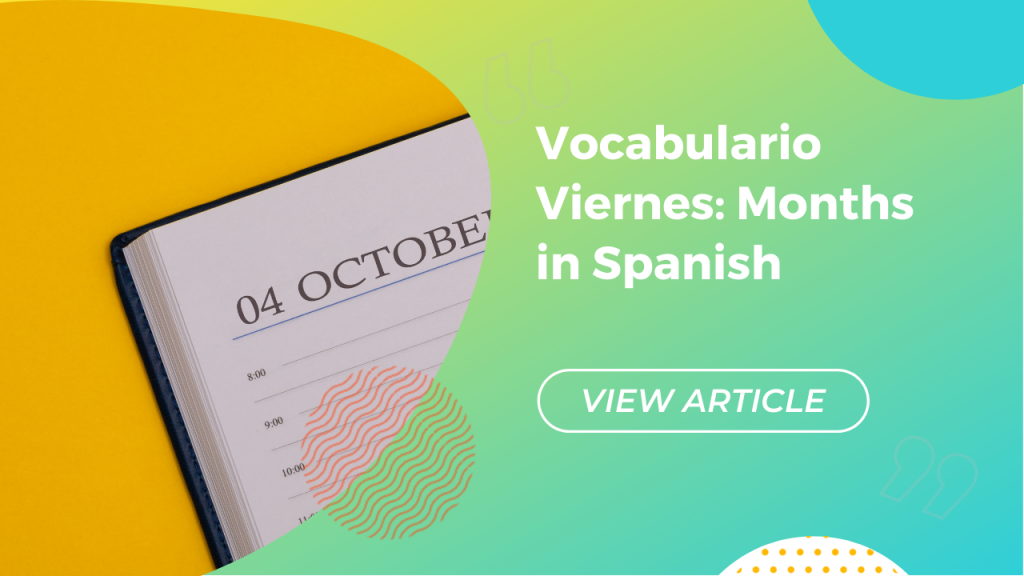
Welcome back to Vocabulario Viernes! Today, we’re continuing our vocabulary about the calendar in Spanish. If you haven’t seen it yet, check out of our last Vocabulario Viernes on days of the week. After learning the days of the week and the format of a calendar in Spanish, here we’ll show you the months in […]













 Français
  English
  Español
  Italiano
  Polski
  Русский