- [email protected]
- +34 961258767
- Av. del Marqués de Sotelo 3, Floor 2, Door 4, 46002 Valencia
Аккредитованный центр Института Сервантеса
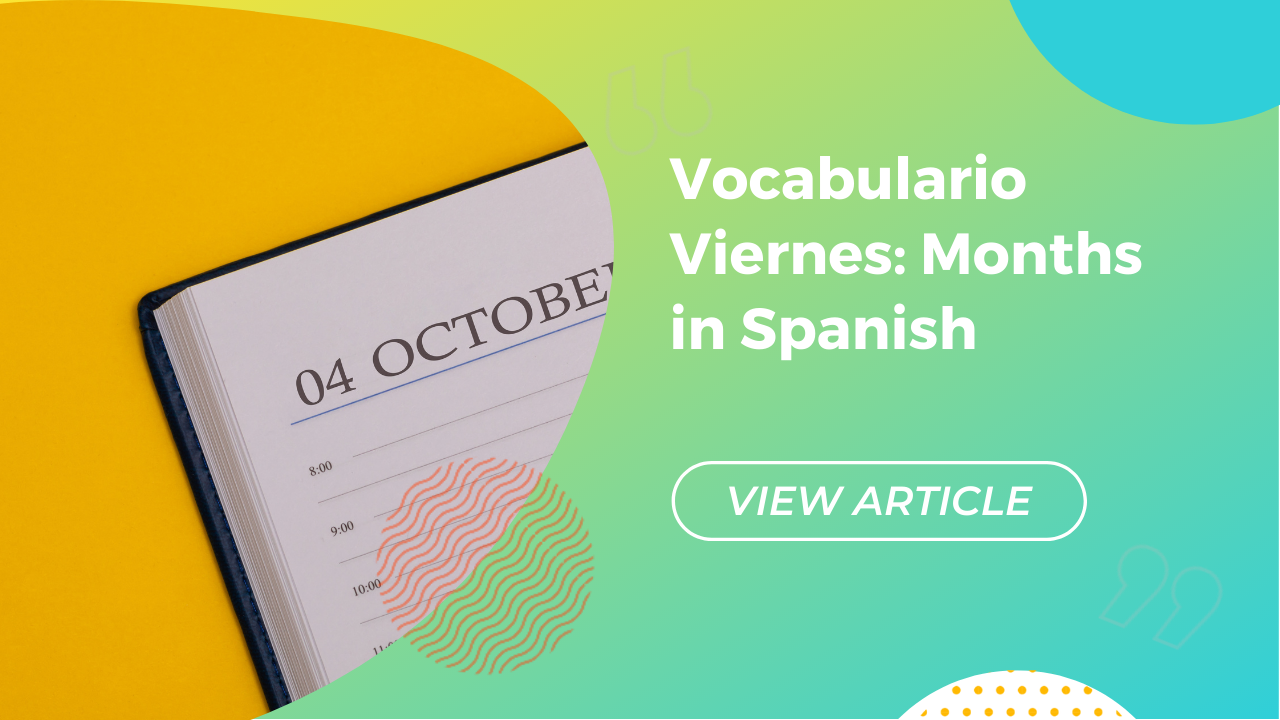
Welcome back to Vocabulario Viernes! Today, we’re continuing our vocabulary about the calendar in Spanish. If you haven’t seen it yet, check out of our last Vocabulario Viernes о днях недели. После изучения дней недели и формата календаря на испанском языке, здесь мы покажем тебе месяцы на испанском. Продолжай читать, чтобы узнать больше!
Помнишь ли ты, что дни недели в испанском языке не пишутся с большой буквы? То же самое касается и месяцев! Если ты присмотришься, то увидишь, что многие из них очень похожи на свое значение в английском языке. Надеюсь, так тебе будет проще запомнить.
Теперь, когда мы знаем дни недели, мы можем комбинировать их, числа и месяцы, чтобы спросить и сказать дату. Во-первых, чтобы спросить у кого-то, какой сегодня день, мы можем спросить, “Cuál es la fecha de hoy?” Также ты можешь услышать сокращение - просто спроси, “¿Cuál es la fecha?” ¡Ojo! Notice how we use the вопросительное слово cuál instead of qué в этой фразе.
There’s a handy formula to state the date:
el ______ de _______
In the first space, we will say the number of the date. In the second space, we will say the month. Did you notice that it’s flipped from in English? In English, I would say “July 22” where the month comes before the number. In Spanish, it’s the opposite. I would say “el 22 de julio.” Remember, months are lower case!
Now, let’s put it together in a full sentence. To say “It’s July 22” you would use the verb “es”, so you would say “Es el 22 de julio.” If you want to be extra specific, you could say “Hoy es el 22 de julio.” Practice with your friends or classmates because every day is a new opportunity to say a new phrase!













 Русский
  English
  Español
  Italiano
  Français
  Polski