Don’t be intimidated by the irregular present subjunctive. Just like every other new conjugation, it seems hard at first but will feel like second nature. What makes the subjunctive particularly challenging for Spanish learners is that it’s different than English. It doesn’t have an easy exact translation for native English speakers, but that just means […]
One of the greatest skills that comes with advancing your Spanish is being able to talk about opinions. To do so, some verbs with prepositions are common. This means that there are verbs that always use a specific preposition. By learning these, you’ll boost your vocabulary and feel more confident using the subjunctive to talk […]
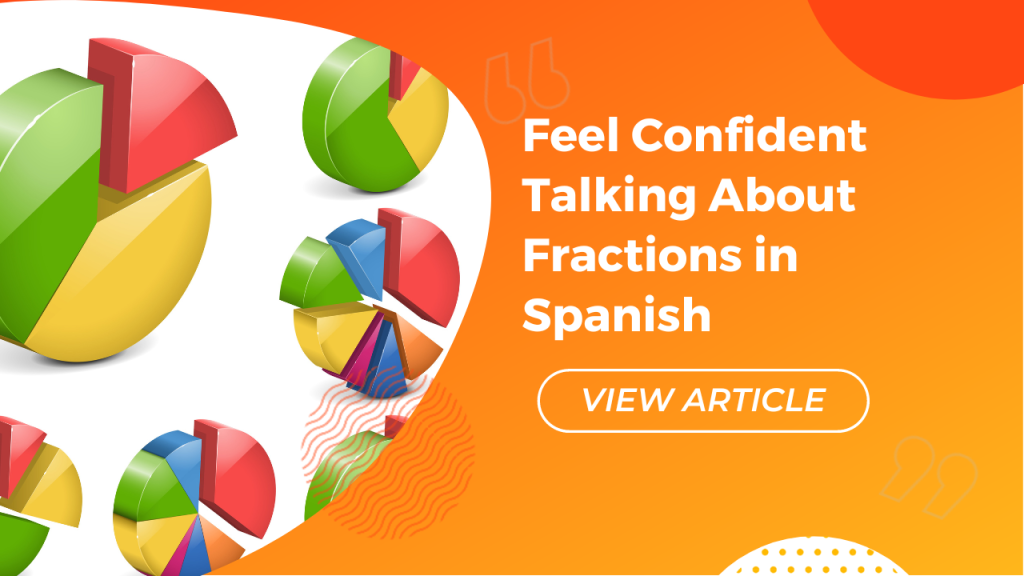
Don’t worry, this isn’t going to be a complicated math lesson. There are actually many average daily actions that would require you to talk about fractions in Spanish. Think about if you want half of a sandwich at a deli. Maybe you want to say you only read 1/4 of a book. These typically require […]

You probably remember learning about past participles with the verb haber. In English, a past participle is a form of a verb that usually ends in –ed. However, they can take on many different forms depending on what language that verb comes from. In Spanish, past participles are actually extremely common as adjectives. You might […]

When learning a new language, you usually start off learning chunk phrases, then things you do habitually. After that, you’ll want to talk about the past or the future. When you want to talk about your hopes and dreams, there are a few different grammatical constructions you can use, no matter what level you’re at. […]
It might sound scary, but apocopation is actually something quite simple. In fact, it’s common in English, and lots of other languages, too! All it means is that there are some words that you shorten by taking off the end of a word. Sometimes this is just in spoken conversation, but sometimes it’s a core […]
You’ve probably spent countless hours trying to learn which Spanish nouns are feminine and which are masculine. Some of them are more obvious, where masculine nouns that end in -o are masculine and ones that end in -a are feminine. Knowing grammatical gender in Spanish is crucial to all kinds of grammar topics, but did […]
The conditional tense gets its name because you’re describing what would or could happen in the future given certain circumstances or conditions. It’s often used for hypothetical situations or making requests politely. In fact, it’s similar in English! We often ask, “Could you … ?” to ask someone politely to do something. That’s the conditional! […]
In addition to learning common nouns and verbs to express yourself in another language, it’s just as important to learn common words of frequency. These expressions help you say how often you do things or when you do certain things. In addition to memorizing them, you’ll also have to know where they go. Keep reading […]

When learning more complicated vocabulary words, sometimes it’s easy to forget the basics! There are lots of words in English that have additional prefixes or suffixes, but contain a much simpler word. For example, the word “preview” contains the word “view”, but it has the little word “pre-” as its suffix. These little words can […]














 Русский
  English
  Español
  Italiano
  Français
  Polski