- [email protected]
- +34 961258767
- Av. del Marqués de Sotelo 3, Planta 2, Puerta 4, 46002 Valencia
Centro Acreditado por el Instituto Cervantes
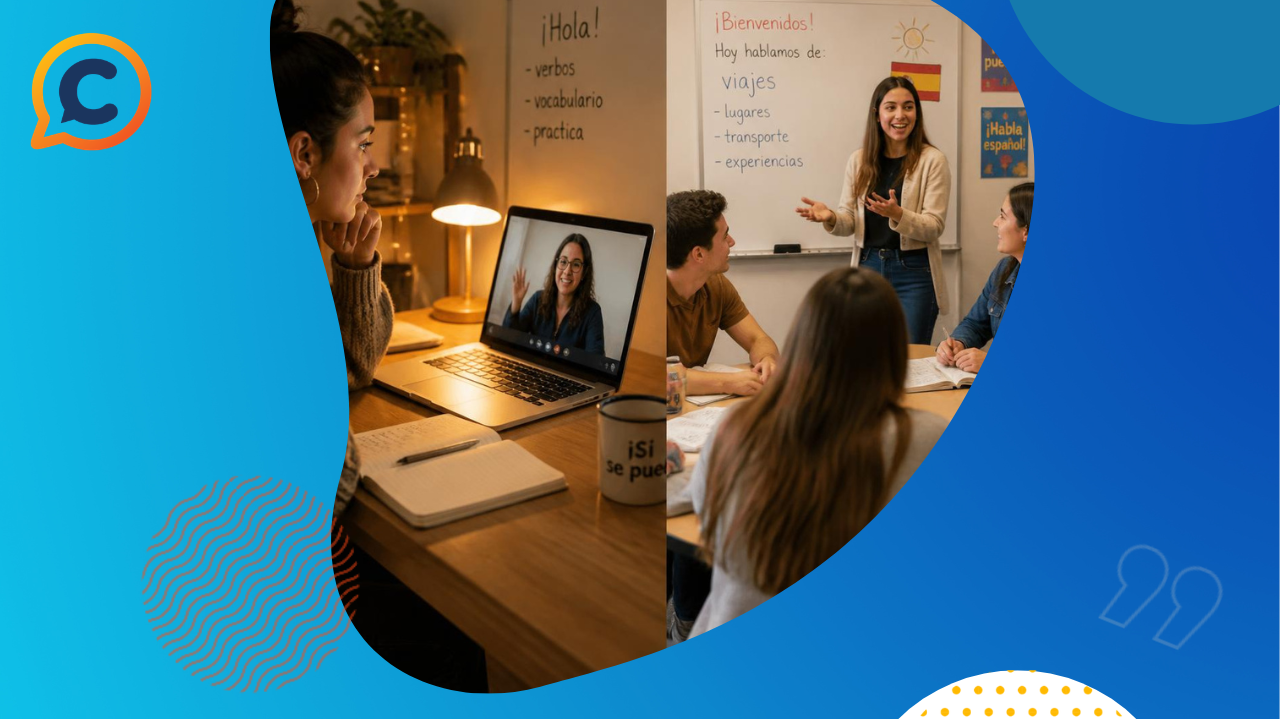
Si estás pensando en aprender español, una de las primeras decisiones a las que probablemente te enfrentes es cómo quieres tomar tus clases. ¿Deberías estudiar desde casa con clases de español online, o buscar una escuela y aprender cara a cara?
La respuesta no es tan simple como decir que una opción es mejor. Depende de tus horarios, dónde vivas, cómo aprendas mejor y qué quieras lograr.
Un estudiante universitario que pasa un semestre en España tiene necesidades muy diferentes a las de un profesional que encaja el español en un trabajo a tiempo completo. Y alguien que se prepara para mudarse a España puede beneficiarse de un enfoque distinto.
Así que, en vez de preguntar “¿Cuál es mejor?”, una pregunta más útil es:
¿Qué tipo de clase de español se adapta a mi vida y a mis metas?
Vamos a ver qué ofrece cada opción.
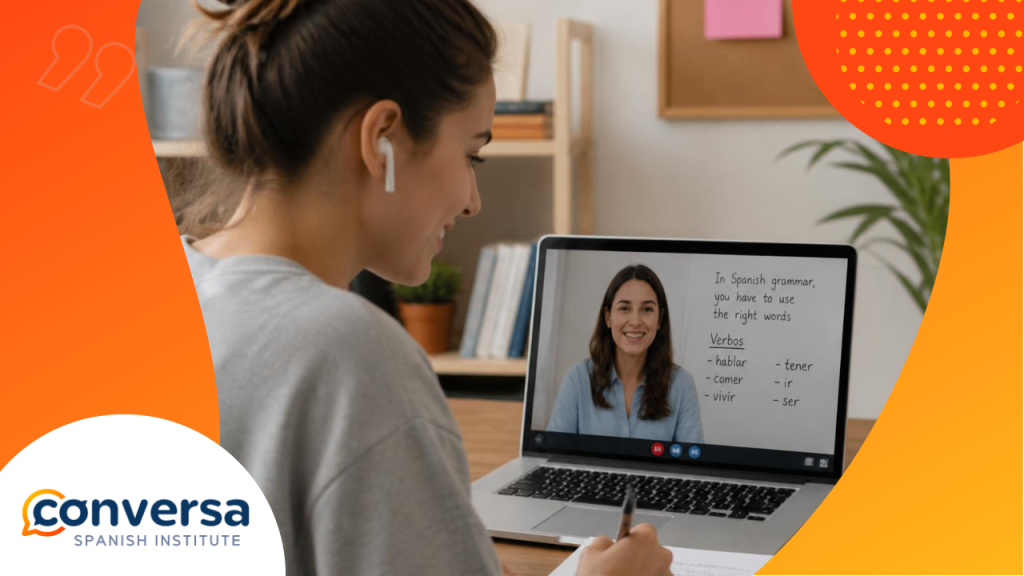
Las clases de español en línea han recorrido un largo trecho desde ver videos grabados o hacer ejercicios de gramática en una app. Con las clases en vivo, puedes trabajar directamente con un profe, hacer preguntas, practicar cómo hablar y recibir comentarios sin estar en la misma habitación.
Para muchos estudiantes, esa flexibilidad es la mayor ventaja.
Si trabajas a tiempo completo, estudias en la universidad o tienes un horario que cambia todas las semanas, ir a una escuela de idiomas varias veces por semana no siempre es realista.
Las clases online te quitan el viaje y hacen que sea más fácil meter el español en tu rutina diaria. Puedes tomar una clase antes del trabajo, en la hora del almuerzo o por la noche, según tu programa.
Esto puede marcar una gran diferencia a largo plazo. Al fin y al cabo, un curso al que puedes ir de forma constante suele ser más útil que uno que se ve perfecto sobre el papel pero no encaja con tus horarios.
Otra ventaja obvia es la ubicación.
No hace falta que vivas en Valencia, Madrid o en otra ciudad hispanohablante para trabajar con un profe de español. Puedes estudiar desde tu casa, tu residencia de estudiantes o incluso mientras viajas.
Esto es especialmente útil para los profesionales que viajan mucho o para los estudiantes que quieren seguir aprendiendo español cuando no están en clase.
También significa que puedes empezar a aprender antes de tu viaje a un país hispanohablante en vez de esperar hasta llegar.
Una preocupación común es que las clases en línea no ofrezcan suficiente interacción.
Eso puede ser verdad si solo usas una app, IA o ves videos por tu cuenta. Pero las clases en vivo online son otra cosa.
Aún puedes:
Para los estudiantes que prefieren atención personalizada, las clases particulares de español en línea pueden ser especialmente útiles. Le permiten al profe adaptar el ritmo, las actividades y el contenido a tus necesidades individuales.
Para alguien con un trabajo exigente, la flexibilidad no es solo cómoda. Puede ser la diferencia entre aprender español y dejarlo siempre para después.
Un profesional que necesita español para el trabajo tal vez no necesite un curso intensivo todas las mañanas. Puede que le sirva más una clase online normal una o dos veces por semana, combinada con práctica por su cuenta.
Lo mismo aplica para la gente que se está preparando para mudarse al extranjero. Empezar con clases online te puede ayudar a armar una base antes de llegar. [Échale un vistazo a nuestro artículo sobre 5 errores comunes al aprender español en el extranjero (y cómo evitarlos)]
Aprender en línea es cómodo, pero hay algo diferente en estar físicamente en un aula.
Oyes a la gente hablar a tu alrededor. Conversations ocurren de manera natural entre las actividades. Puedes hacerle una pregunta a un compañero de clase, practicar con alguien o seguir charlando con un café después de la clase.
Para algunos estudiantes, el ambiente presencial marca una gran diferencia.
En una clase presencial, la comunicación no siempre se acaba cuando el profe termina de explicar algo.
Puedes charlar con la persona de al lado mientras esperas a que empiece la clase. Puede que escuches la pregunta de otro estudiante y te des cuenta de que tenías la misma. O puede que termines haciéndote amigo de tus compañeros y hablando español juntos después de clase.
Estas interacciones no siempre están planeadas, pero son muy valiosas.
El idioma no consiste solo en crear frases gramaticalmente correctas. También se trata de reaccionar, escuchar, entender a los demás y mantener una conversation.
Para algunos estudiantes, ir físicamente a clase crea una estructura útil.
Tienes un sitio a donde ir, un horario fijo y una separación clara entre el tiempo de estudio y todo lo demás.
Eso puede ser especialmente útil si te cuesta mantener la motivación cuando estudias desde casa.
También hay algo útil a nivel psicológico en entrar a un salón de clases y pensar:, “Este es mi rato en español.”
If you’re already living in Spain, in-person classes can become part of your social life as well as your education.
You meet other international students who are going through a similar experience. You may come from completely different countries but have the same challenge: trying to order lunch without switching to English.
That shared experience can make learning more enjoyable—and it can give you more reasons to use Spanish outside class.
This is where the choice becomes particularly interesting.
If you’re already living in Spain, in-person lessons can complement the immersion happening around you.
Imagine studying how to order food in class in the morning and then using that language at a local café a few hours later. Or practicing directions before navigating a new part of the city.
The classroom gives you the tools. Everyday life gives you somewhere to use them.
Valencia is a good example of this combination. A student can attend a Spanish class in the morning, have lunch at a local restaurant, practice Spanish at a market, and spend the afternoon exploring the city. [Learn more about Cómo las actividades culturales mejoran tu experiencia de aprendizaje del español]
That doesn’t mean online lessons stop being useful when you’re in Spain. Quite the opposite. Online classes can be a convenient way to continue studying when you’re traveling, working, or unable to get to school.
The important thing is to think about what role the lessons need to play in your life.
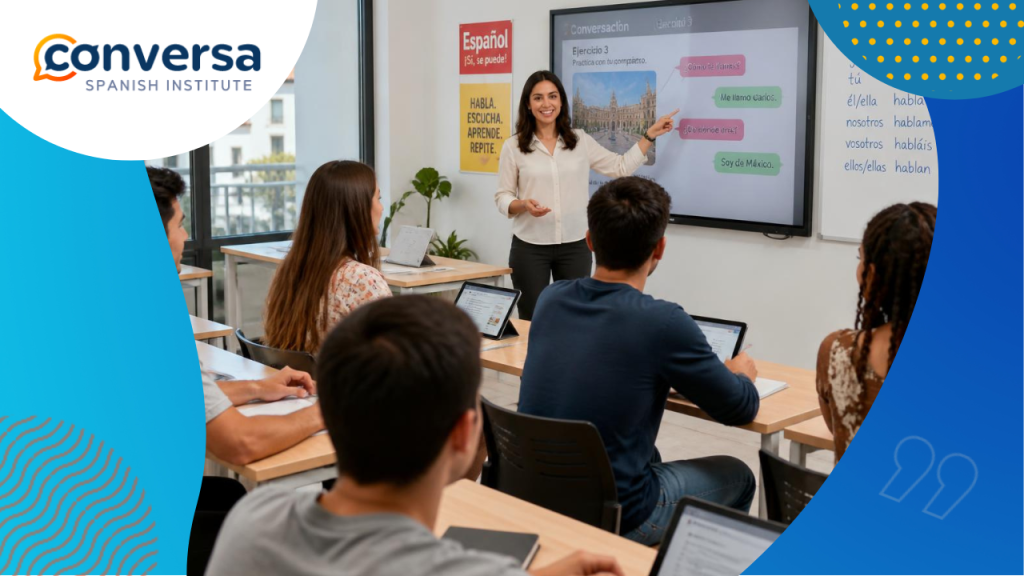
There’s no perfect format for everyone. Your ideal Spanish course depends on what your everyday life looks like and what you want to achieve.
Have a busy or unpredictable schedule
If you’re balancing a full-time job, university, or other commitments, online lessons can make Spanish easier to fit into your week.
You don’t need to commute, and you can often choose lesson times that work around your existing routine.
Travel frequently
If you’re regularly moving between cities or countries, online classes allow you to keep learning without having to find a new school every time you move.
Don’t live near a good Spanish school
You don’t have to live in a Spanish-speaking country to learn with a qualified teacher. Online lessons can give you access to teachers and programs that wouldn’t otherwise be available locally.
Prefer a quieter learning environment
Some people simply concentrate better at home. If you feel more comfortable asking questions or speaking Spanish when you’re not surrounded by other students, online lessons can be a good fit.
Want to combine lessons with independent study
Online classes can work particularly well alongside podcasts, reading, apps, a Spanish journal, or other forms of independent practice.
The key is not to let flexibility turn into inconsistency. If you keep postponing your lessons because you’re busy, even the most convenient course won’t get you very far.
Are living in Spain
If you’ve moved to Spain specifically to learn Spanish, being physically present at a language school gives you another opportunity to make Spanish part of your everyday life.
For example, if you’re studying in Valencia, you can use what you learn in class immediately when ordering lunch, shopping at a market, or chatting with people around the city.
Learn better through interaction
Some people thrive on face-to-face communication. Seeing someone’s expressions, gestures, and reactions can add another layer to the conversation.
It’s also easier for spontaneous exchanges to happen when everyone is in the same room.
Want a stronger social experience
If you’re moving abroad on your own, a language school can be a natural place to meet people.
Your classmates may become travel companions, friends, or simply people you share the ups and downs of learning a new language with.
Need external structure
If you know that studying from home requires more discipline than you have, attending a physical class can help.
Having a fixed location and schedule creates a routine that makes it easier to stay committed.

Not everyone wants a standard group course.
Maybe you need Spanish for a specific job. Perhaps you’re preparing for an exam, getting ready to move to Spain or struggling with a particular aspect of the language.
In those situations, private Spanish lessons can be worth considering.
One-to-one lessons give you more control over what you work on and how quickly you progress. Your teacher can adapt activities to your level, interests, and objectives instead of following the same pace as a group.
And private lessons don’t have to mean choosing between online and in-person learning. Depending on the school, you may be able to take them in either format.
There’s another useful distinction to make.
You might not actually need more Spanish lessons. You might need more opportunities to speak Spanish.
If you understand a lot but freeze when someone asks you a question, conversation-focused Spanish lessons can be particularly useful.
These classes put speaking at the center of the lesson and give you structured opportunities to practice expressing yourself, reacting to questions, and keeping conversations going.
Conversation lessons can be a useful option for learners who already have some Spanish and want to become more confident using it.
This is especially relevant for people who have studied Spanish for years but still find real conversations intimidating.
Absolutely—and for some learners, this may be the most practical option.
Por ejemplo:
This kind of combination can be particularly useful for professionals and long-term students whose schedules change throughout the year.
It can also help you keep learning when circumstances change. Moving away from Spain doesn’t have to mean stopping your Spanish course, just as traveling doesn’t have to mean abandoning your progress.
Conversa, for example, offers both online and face-to-face Spanish classes in Valencia, so students can choose the format that works best for their circumstances.
The important thing is to make sure the different parts of your learning support the same overall goal.
Still not sure?
Try this quick test.
Your priority is flexibility?
Online Spanish classes may be the better option.
You’re living in Spain and want maximum interaction?
In-person lessons could be a better fit.
You have a very specific learning goal?
Consider private lessons.
You understand Spanish but need more confidence speaking?
Look at conversation-focused lessons.
Your schedule or location changes regularly?
Online classes can give you more continuity.
You want the full study-abroad experience?
In-person classes can become part of your social and cultural experience.
And if more than one of these applies to you, that’s fine. You don’t have to force yourself into a single category.
The short answer is: it depends on you.
Online Spanish classes are ideal for learners who value flexibility, convenience, and continuity. They’re particularly useful for busy professionals, university students, frequent travelers, and people who don’t live near a suitable language school.
In-person lessons are a strong choice for learners who value face-to-face interaction, structure, and the social side of learning. If you’re already living in Spain, they can also become part of a much broader immersion experience.
Neither option automatically produces better results. What matters more is whether the course gives you regular interaction with a teacher, meaningful opportunities to speak, useful feedback, and a learning routine you can maintain.
The best Spanish class is ultimately the one that fits your life well enough for you to keep showing up—and gives you enough real communication to make Spanish part of your life.
So before choosing a format, ask yourself one final question:
What kind of Spanish learning experience can I realistically see myself sticking with?
Your answer will probably tell you more than any comparison table ever could.
 English English
  Español
 Italiano
 Français
 Polski
 Русский