- [email protected]
- +34 961258767
- Av. del Marqués de Sotelo 3, Floor 2, Door 4, 46002 Valencia
Centre accrédité par l'Instituto Cervantes
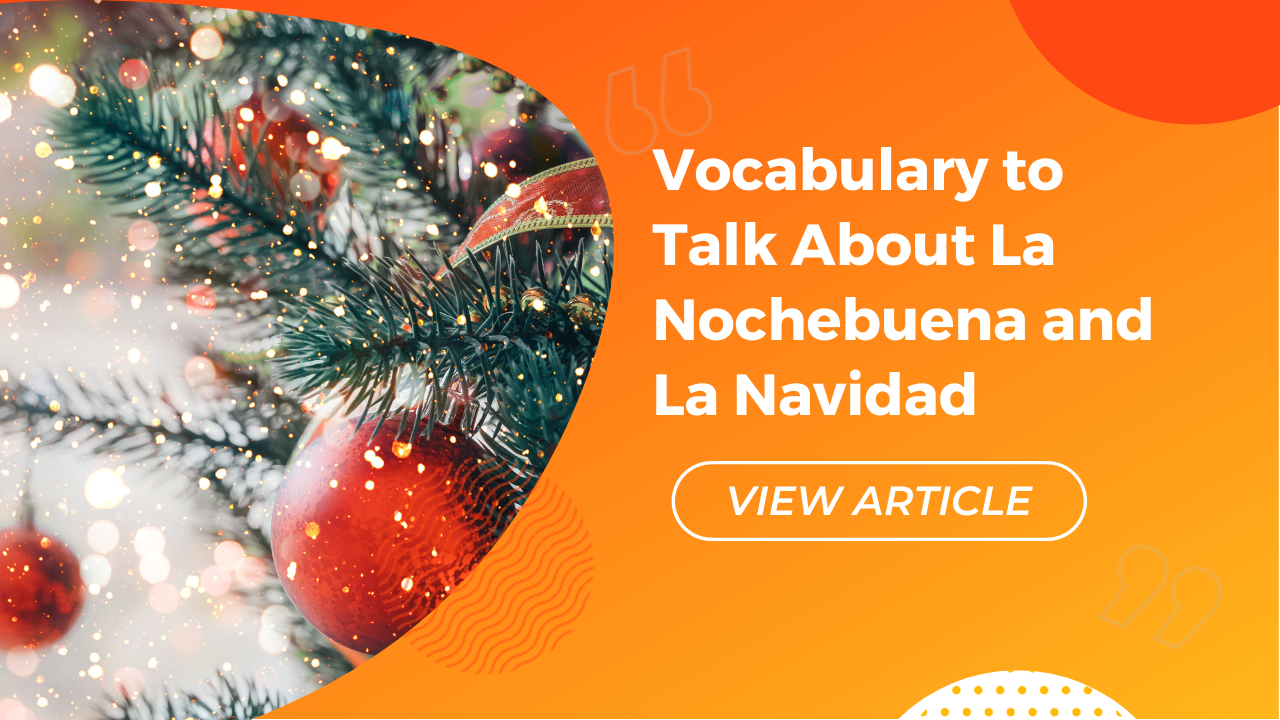
Christmas has come and gone, but that doesn’t mean we’re done talking about it! Now that the holidays are over and you’re seeing your friends and coworkers, you’re probably talking about what you did. We want to give you vocabulary to talk about la Nochebuenaou la veille de Noël, et la Navidadou le jour de Noël. Ces mots t'aideront à partager la façon dont tu as passé ton temps libre. De plus, tu peux demander ce que quelqu'un d'autre a fait, ou même mieux comprendre les vidéos de vacances que tu vois en ligne.
First, you’ll notice that the Spanish-speaking world likely has different holiday traditions than you do. Every country and region has different foods and customs. For example, you’ll see Spaniards grignoter turrónmais tes amis mexicains préféreront peut-être buñuelos.
Dans certains pays, il fait froid dehors pendant la période de Noël, mais dans l'hémisphère sud, il peut faire plus chaud. Cela a une incidence sur ce que les différentes cultures font pour le dîner pendant les fêtes, et sur les aliments qu'elles préparent.
That being said, there aren’t too many common traditions that all Spanish-speaking countries celebrate because of how different every country’s culture is. We’ll give you vocabulary to help you be able to communicate some of the most popular holiday traditions, but we’d love for you to let us know more that you do in the comments!
First, let’s take a look at verbs in the past to talk about what you did in the past. If you’re talking about an action that has a set start and end point, or happened just once, you’re going to want to use the preterite tense. However, if you’re talking about things you used to do when you were younger, you’ll want to use the imperfect tense. If you want to talk about what you do habitually, you’ll use the present tense. It’s totally fine if you need a little refresher on the prétérit vs. imparfait ou au présent !
Maintenant, voici quelques aliments dont tu pourrais parler :
Ensuite, voici du vocabulaire autour de différentes activités auxquelles toi ou ton ami avez pu participer :
Nous espérons que ces mots t'aideront à communiquer et à partager tes traditions de vacances préférées !
 English English
  Español
 Italiano
 Français
 Polski
 Русский