- [email protected]
- +34 961258767
- Av. del Marqués de Sotelo 3, Piano 2, Porta 4, 46002 Valencia
Centro accreditato dall'Instituto Cervantes
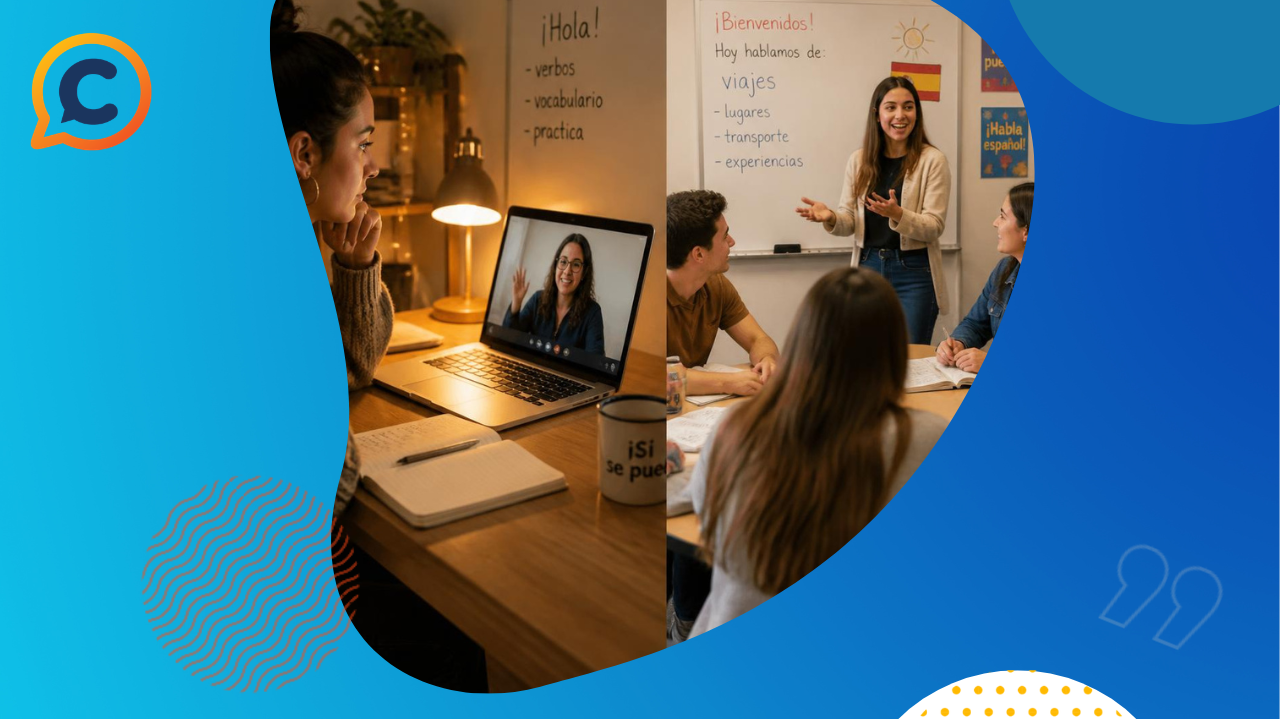
If you’re thinking about learning Spanish, one of the first decisions you’ll probably face is how you want to take your classes. Should you study from your home with online Spanish classes, or find a school and learn face-to-face?
The answer isn’t as simple as saying one option is better. It depends on your schedule, where you live, how you learn best, and what you want to achieve.
A university student spending a semester in Spain has very different needs from a professional fitting Spanish around a full-time job. And someone preparing for a move to Spain may benefit from a different approach.
So, instead of asking “Which is better?”, a more useful question is:
Which type of Spanish class fits my life and my goals?
Let’s look at what each option offers.
Online Spanish classes have come a long way from watching recorded videos or completing grammar exercises on an app. With live classes, you can work directly with a teacher, ask questions, practice speaking, and receive feedback without being in the same room.
For many learners, that flexibility is the biggest advantage.
If you work full-time, study at university, or have a schedule that changes from week to week, travelling to a language school several times a week isn’t always realistic.
Online lessons remove the commute and make it easier to fit Spanish into your existing routine. You can take a class before work, during a lunch break, or in the evening, depending on your program.
This can make a big difference in the long term. After all, a course you can attend consistently is usually more useful than one that looks perfect on paper but doesn’t fit your schedule.
Another obvious advantage is location.
You don’t need to live in Valencia, Madrid, or another Spanish-speaking city to work with a Spanish teacher. You can study from your home, your university accommodation, or even while traveling.
This is particularly useful for professionals who travel frequently or for students who want to continue learning Spanish when they’re away from the classroom.
It also means you can start learning before your trip to a Spanish-speaking country rather than waiting until you arrive.
One common concern is that online lessons won’t provide enough interaction.
That can certainly be true if you’re simply using an app, IA, or watching videos on your own. But live online lessons are different.
You can still:
For learners who prefer one-to-one attention, online private Spanish lessons can be particularly useful. They allow the teacher to adapt the pace, activities, and content to your individual needs.
For someone with a demanding job, flexibility isn’t just convenient. It may be the difference between learning Spanish and constantly putting it off.
A professional who needs Spanish for work might not need an intensive course every morning. They may benefit more from a regular online lesson once or twice a week, combined with independent practice.
The same applies to people preparing for a move abroad. Starting with online lessons can help you build a foundation before you arrive. [Check out our article on 5 errori comuni quando si impara lo spagnolo all'estero (e come evitarli)]
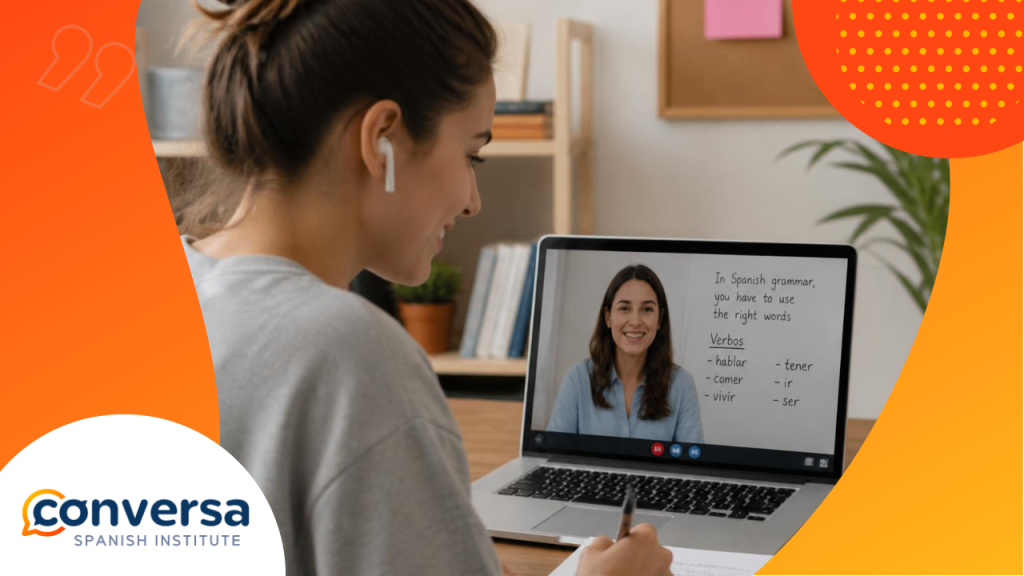
Online learning is convenient, but there’s something different about being physically present in a classroom.
You hear people speaking around you. Conversations happen naturally between activities. You can ask a classmate a question, practice with a partner, or continue talking over coffee after the lesson.
For some learners, the in-person environment makes a real difference.
In a physical classroom, communication doesn’t always stop when the teacher finishes explaining something.
You might chat with the person next to you while waiting for class to start. You might hear another student’s question and realize you had the same one. Or you might end up making friends with classmates and speaking Spanish together after school.
These interactions aren’t always planned, but they’re very valuable.
Language isn’t only about producing grammatically correct sentences. It’s also about reacting, listening, understanding other people, and keeping a conversation going.
For some students, physically going to class creates useful structure.
You have a place to go, a fixed schedule, and a clear separation between study time and everything else.
That can be particularly helpful if you find it difficult to stay motivated when studying from home.
There’s also something psychologically useful about walking into a classroom and thinking, “This is my Spanish time.”
If you’re already living in Spain, in-person classes can become part of your social life as well as your education.
You meet other international students who are going through a similar experience. You may come from completely different countries but have the same challenge: trying to order lunch without switching to English.
That shared experience can make learning more enjoyable—and it can give you more reasons to use Spanish outside class.
This is where the choice becomes particularly interesting.
If you’re already living in Spain, in-person lessons can complement the immersion happening around you.
Imagine studying how to order food in class in the morning and then using that language at a local café a few hours later. Or practicing directions before navigating a new part of the city.
The classroom gives you the tools. Everyday life gives you somewhere to use them.
Valencia is a good example of this combination. A student can attend a Spanish class in the morning, have lunch at a local restaurant, practice Spanish at a market, and spend the afternoon exploring the city. [Learn more about Come le attività culturali migliorano l'esperienza di apprendimento dello spagnolo]
That doesn’t mean online lessons stop being useful when you’re in Spain. Quite the opposite. Online classes can be a convenient way to continue studying when you’re traveling, working, or unable to get to school.
The important thing is to think about what role the lessons need to play in your life.
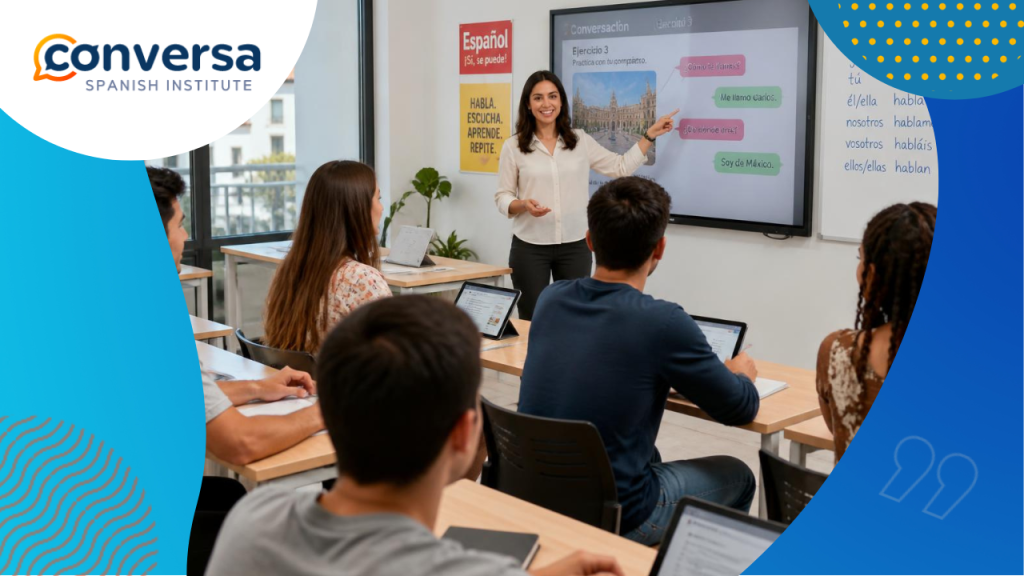
There’s no perfect format for everyone. Your ideal Spanish course depends on what your everyday life looks like and what you want to achieve.
Have a busy or unpredictable schedule
If you’re balancing a full-time job, university, or other commitments, online lessons can make Spanish easier to fit into your week.
You don’t need to commute, and you can often choose lesson times that work around your existing routine.
Travel frequently
If you’re regularly moving between cities or countries, online classes allow you to keep learning without having to find a new school every time you move.
Don’t live near a good Spanish school
You don’t have to live in a Spanish-speaking country to learn with a qualified teacher. Online lessons can give you access to teachers and programs that wouldn’t otherwise be available locally.
Prefer a quieter learning environment
Some people simply concentrate better at home. If you feel more comfortable asking questions or speaking Spanish when you’re not surrounded by other students, online lessons can be a good fit.
Want to combine lessons with independent study
Online classes can work particularly well alongside podcasts, reading, apps, a Spanish journal, or other forms of independent practice.
The key is not to let flexibility turn into inconsistency. If you keep postponing your lessons because you’re busy, even the most convenient course won’t get you very far.
Are living in Spain
If you’ve moved to Spain specifically to learn Spanish, being physically present at a language school gives you another opportunity to make Spanish part of your everyday life.
For example, if you’re studying in Valencia, you can use what you learn in class immediately when ordering lunch, shopping at a market, or chatting with people around the city.
Learn better through interaction
Some people thrive on face-to-face communication. Seeing someone’s expressions, gestures, and reactions can add another layer to the conversation.
It’s also easier for spontaneous exchanges to happen when everyone is in the same room.
Want a stronger social experience
If you’re moving abroad on your own, a language school can be a natural place to meet people.
Your classmates may become travel companions, friends, or simply people you share the ups and downs of learning a new language with.
Need external structure
If you know that studying from home requires more discipline than you have, attending a physical class can help.
Having a fixed location and schedule creates a routine that makes it easier to stay committed.

Not everyone wants a standard group course.
Maybe you need Spanish for a specific job. Perhaps you’re preparing for an exam, getting ready to move to Spain or struggling with a particular aspect of the language.
In those situations, private Spanish lessons can be worth considering.
One-to-one lessons give you more control over what you work on and how quickly you progress. Your teacher can adapt activities to your level, interests, and objectives instead of following the same pace as a group.
And private lessons don’t have to mean choosing between online and in-person learning. Depending on the school, you may be able to take them in either format.
There’s another useful distinction to make.
You might not actually need more Spanish lessons. You might need more opportunities to speak Spanish.
If you understand a lot but freeze when someone asks you a question, conversation-focused Spanish lessons can be particularly useful.
These classes put speaking at the center of the lesson and give you structured opportunities to practice expressing yourself, reacting to questions, and keeping conversations going.
Conversation lessons can be a useful option for learners who already have some Spanish and want to become more confident using it.
This is especially relevant for people who have studied Spanish for years but still find real conversations intimidating.
Absolutely—and for some learners, this may be the most practical option.
Ad esempio:
This kind of combination can be particularly useful for professionals and long-term students whose schedules change throughout the year.
It can also help you keep learning when circumstances change. Moving away from Spain doesn’t have to mean stopping your Spanish course, just as traveling doesn’t have to mean abandoning your progress.
Conversa, for example, offers both online and face-to-face Spanish classes in Valencia, so students can choose the format that works best for their circumstances.
The important thing is to make sure the different parts of your learning support the same overall goal.
Still not sure?
Try this quick test.
Your priority is flexibility?
Online Spanish classes may be the better option.
You’re living in Spain and want maximum interaction?
In-person lessons could be a better fit.
You have a very specific learning goal?
Consider private lessons.
You understand Spanish but need more confidence speaking?
Look at conversation-focused lessons.
Your schedule or location changes regularly?
Online classes can give you more continuity.
You want the full study-abroad experience?
In-person classes can become part of your social and cultural experience.
And if more than one of these applies to you, that’s fine. You don’t have to force yourself into a single category.
The short answer is: it depends on you.
Online Spanish classes are ideal for learners who value flexibility, convenience, and continuity. They’re particularly useful for busy professionals, university students, frequent travelers, and people who don’t live near a suitable language school.
In-person lessons are a strong choice for learners who value face-to-face interaction, structure, and the social side of learning. If you’re already living in Spain, they can also become part of a much broader immersion experience.
Neither option automatically produces better results. What matters more is whether the course gives you regular interaction with a teacher, meaningful opportunities to speak, useful feedback, and a learning routine you can maintain.
The best Spanish class is ultimately the one that fits your life well enough for you to keep showing up—and gives you enough real communication to make Spanish part of your life.
So before choosing a format, ask yourself one final question:
What kind of Spanish learning experience can I realistically see myself sticking with?
Your answer will probably tell you more than any comparison table ever could.
 English English
  Español
 Italiano
 Français
 Polski
 Русский