- [email protected]
- +34 961258767
- Av. del Marqués de Sotelo 3, Piano 2, Porta 4, 46002 Valencia
Centro accreditato dall'Instituto Cervantes


Are you learning Spanish and find yourself struggling with grammar? We don’t blame you. Although Spanish doesn’t have a very complex grammar, it’s generally trickier than English grammar. That’s why we want you to forget all your Spanish-related troubles and keep a positive attitude while reading our blogs! Let’s learn Spanish demonstrative and possessive adjectives and enjoy a free online activity below!
Don’t know what they are? That’s okay, you don’t need to become a linguist. Aggettivi dimostrativi sono fondamentalmente le parole che si usano per esprimono la vicinanza della cosa stiamo parlando di in relazione all'oratore. In inglese: questo, quello, questi, quelli. In spagnolo funzionano esattamente allo stesso modo, solo che ci sono tre gradi di vicinanza:
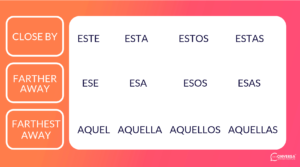
Come puoi vedere, in spagnolo dovremo prestare attenzione al termine genere e numero del sostantivo di cui stiamo parlando. In altre parole:
Inoltre, questi aggettivi possono esprimere non solo la vicinanza spaziale, ma anche quella temporale:
Allo stesso modo, abbiamo gli aggettivi possessivi. La loro funzione è la stessa del dimostrativo ma, come suggerisce il nome, invece di esprimere vicinanza mostrano il possesso in relazione al parlante.
E così via.
Now to the tricky part of today’s grammar lesson. The possessive adjectives take two kinds of forms:
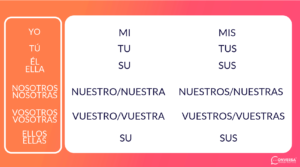
Bear in mind that in Spanish, the adjective will change both depending on the speaker AND on the object/person we’re referring to. So let’s check the table below:
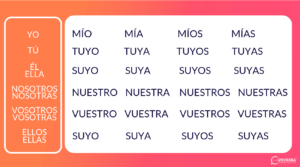
In English, when we say “this cat of mine”, we don’t know the gender of the cat. But in Spanish we would be specific, and the possessive adjective will have to match the gender:
Come al solito, allo spagnolo piace specificare sesso e numero all the time. It’s not the most practical, but it’s not too hard to learn. In this case, -o per maschio, -a per le donne –s per plurale. Semplicemente. Quindi non lasciarti intimidire da tutte le diverse forme. Come diciamo sempre, con il tempo e la pratica queste forme entreranno a far parte del tuo vocabolario.
And don’t forget to check out this free online activity below… Click on the lightbulb on the left upper corner to get the English translation of each sentence. It’s a hard one this time!
 English English
  Español
 Italiano
 Français
 Polski
 Русский