- [email protected]
- +34 961258767
- Av. del Marqués de Sotelo 3, Piano 2, Porta 4, 46002 Valencia
Centro accreditato dall'Instituto Cervantes
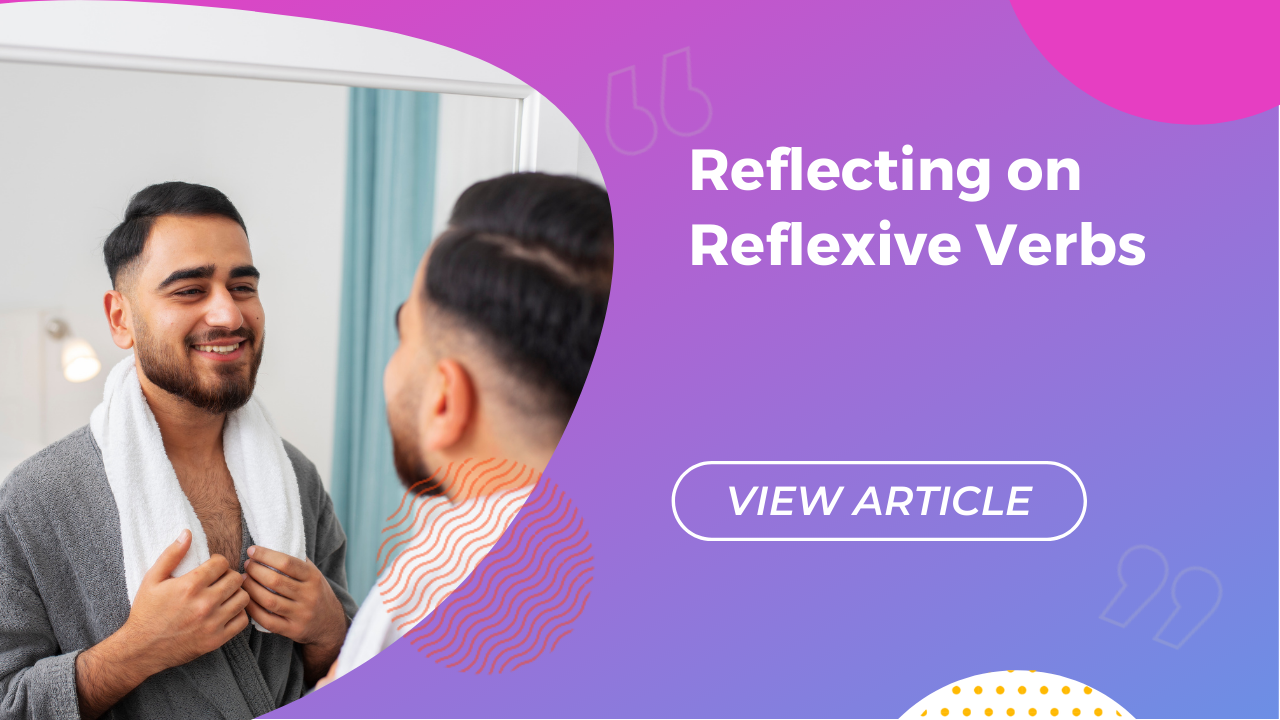
At the very beginning of your Spanish classes, you probably learned “Me llamo…” to say “My name is…” but did you know it literally translates to “I call myself”? In fact, this introductory phrase is part of a category of verbs called reflexive verbs. There are lots of reflexive verbs in Spanish that have special rules, and we’ll explain them more here.
Si tratta di verbi in cui la persona che compie l'azione è anche quella che la riceve. La maggior parte dei verbi ha un soggetto, colui che compie l'azione, e un oggetto, colui che riceve l'azione. In molti casi, il soggetto e l'oggetto sono diversi. Nel caso dei verbi riflessivi, sei tu a compiere l'azione verso te stesso. Puoi considerarli come verbi riflessivi perché l'azione si riflette sul soggetto, come un riflesso in uno specchio.
The tricky part about learning reflexive verbs in Spanish is that most of them aren’t exactly the same in English. For example, a really common verb is “despertarse” which in English means “to wake up.” In English, you don’t really say “to wake oneself up,” but that’s how it literally translates in Spanish.
First, we have to be able to identify reflexive verbs. Verbs end in -ar, -er or -ir, but reflexive verbs will have a -se at the end of them. Looking at “despertarse,” we see the -ar ending in “despertar” and then the -se ending at the end. This tells us that despertarse is a reflexive verb. This means that we can split reflexive verbs into two parts: il verbo principale and the reflexive component “-se.”
The main verb conjugates just like normal- based on the subject and the tense. However, we have to make sure to conjugate the “-se” too. First, move it to the front of the verb. Then, you’re going to conjugate it based on the subject. Remember, reflexive verbs mean that whoever is doing the action does it to themself. There are 6 reflexive pronouns that you need to know. We’ll show you them along, and in context of the verb despertarse.
yo me -> me despierto
tú te -> te despiertas
él/ella/usted se -> se despierta
nosotros(as) nos -> nos despertamos
vosotros(as) os -> se despertáis
ellos/ellas/ustedes se -> se despiertan
Ci sono molti verbi riflessivi comuni in spagnolo oltre a despertarse. Alcuni di essi sono:
Ci sono molti altri verbi riflessivi in spagnolo e, in breve tempo, li userai sempre come un professionista!














 Italiano
  English
  Español
  Français
  Polski
  Русский