- [email protected]
- +34 961258767
- Av. del Marqués de Sotelo 3, Floor 2, Door 4, 46002 Valencia
Accredited Center by Instituto Cervantes
The Spanish verbs ser (to be) and tener (to have) are two of the most frequently-used verbs in the language. If you have recently taken up Spanish, you may have noticed that you kind of have to use them from day one: ¡Hola! Soy Miriam y tengo 14 años (Hi! I’m Miriam and I’m 14 years old).
However, although very distinctive at first glance, one may notice that what can be expressed with one of these verbs in one language may not necessarily carry across international waters.
This is the case with ‘to be’ in English and tener in Spanish.
So, what do I mean, exactly? Let’s first look at tener.
Depending on your level of Spanish, you may or may not know that verbs can be either regular or irregular. What does this mean? Well, long story short: that either they keep their main form no matter the tense is or that they kind of do whatever they want to do.
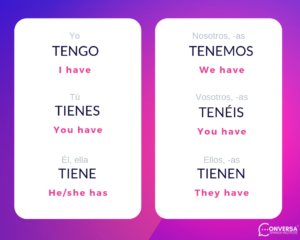
Tener plays for the irregular team. Yup, it’s one of those. Anyway, here’s a reminder of what the present tense looks like:
There are many cases in which the verb “to be” is translated as tener in Spanish, so it is common for language learners on either side to mistake the two. Have you ever heard a native Spanish speaker try their best at English and go: “I have 18 years”? They don’t mean years left to live, obviously (TMI much?), but how old they are.
Let’s look at the most common uses of tener that would correspond to the verb ‘to be’ in English:
Sometimes, though, the same sentences can be translated into two different ways, like ser paciente vs tener paciencia (to be patient vs to have patience).
So? Would you have ever thought that you could say ‘I have hunger’ or ‘I have hurry’ and not sound absolutely ridiculous? Well, now you can! It only goes to show that learning a new language only broadens your mind.
If you want to learn how to speak Spanish, or want to improve your Spanish-speaking skills, start right now! Do this online activity and discover other uses for verbs ser and tener.
 English English
  Español
 Italiano
 Français
 Polski
 Русский