- [email protected]
- +34 961258767
- Av. del Marqués de Sotelo 3, Floor 2, Door 4, 46002 Valencia
Accredited Center by Instituto Cervantes


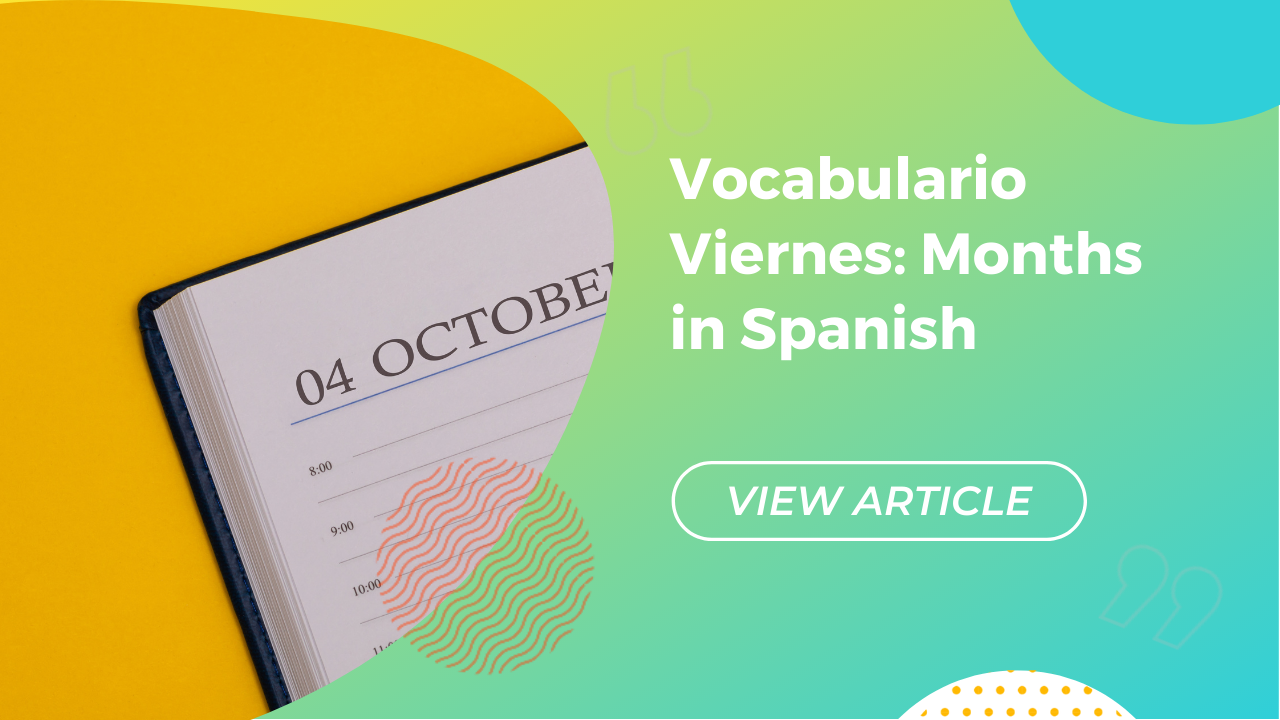
Welcome back to Vocabulario Viernes! Today, we’re continuing our vocabulary about the calendar in Spanish. If you haven’t seen it yet, check out of our last Vocabulario Viernes on days of the week. After learning the days of the week and the format of a calendar in Spanish, here we’ll show you the months in Spanish. Keep reading to learn more!
Do you remember that days of the week aren’t capitalized in Spanish? The same goes for months! If you look closely, you’ll see that a lot of them are very similar to their meaning in English. Hopefully, this will make it easier for you to remember.
Now that we know the days of the week, we can combine them, numbers and months in order to ask and say the date. First, to ask someone what day it is, we can ask, “Cuál es la fecha de hoy?” You might also hear it shortened, simply asking, “¿Cuál es la fecha?” ¡Ojo! Notice how we use the question word cuál instead of qué in this phrase.
There’s a handy formula to state the date:
el ______ de _______
In the first space, we will say the number of the date. In the second space, we will say the month. Did you notice that it’s flipped from in English? In English, I would say “July 22” where the month comes before the number. In Spanish, it’s the opposite. I would say “el 22 de julio.” Remember, months are lower case!
Now, let’s put it together in a full sentence. To say “It’s July 22” you would use the verb “es”, so you would say “Es el 22 de julio.” If you want to be extra specific, you could say “Hoy es el 22 de julio.” Practice with your friends or classmates because every day is a new opportunity to say a new phrase!
 English English
  Español
 Italiano
 Français
 Polski
 Русский